
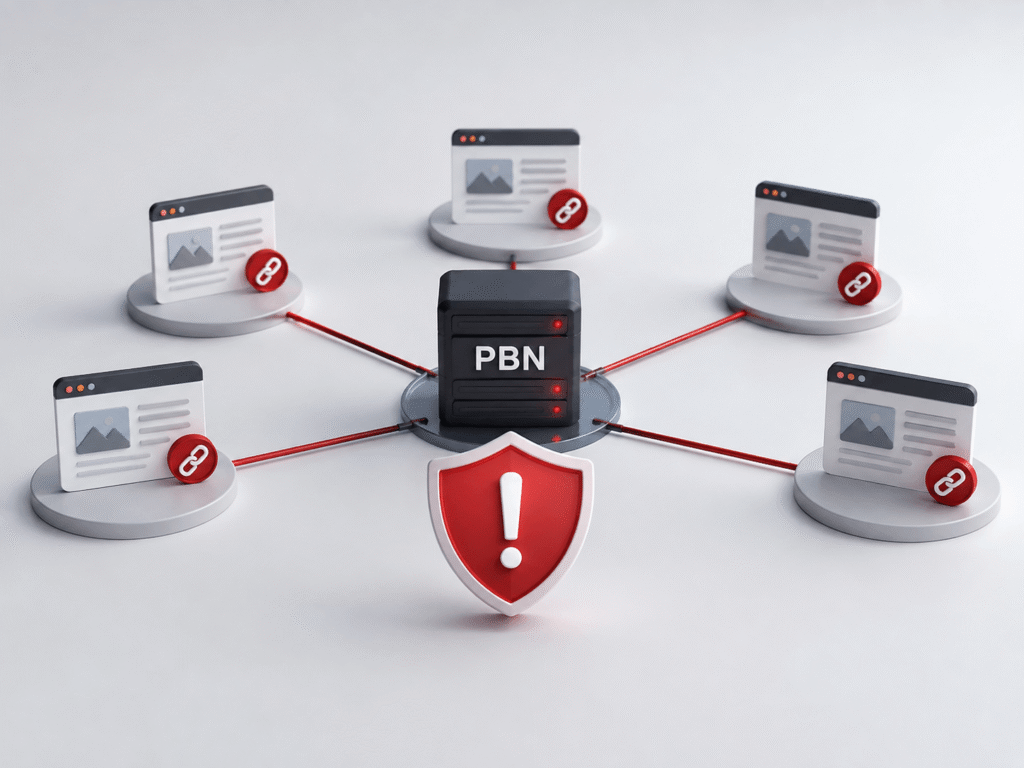
If you’ve researched link building for any length of time, you’ve likely come across the term PBN — private blog network. Providers often market PBNs as a fast, cheap way to acquire backlinks, and on the surface, the pitch can sound appealing. However, PBNs carry real, well-documented risk, so understanding exactly what they are — why search engines actively work to detect them — is essential before you consider any link building offer that sounds too good to be true.
This guide explains what PBNs actually are, how they work, why they violate search engine guidelines, and how to recognize the warning signs when evaluating a potential guest posting or backlink opportunity.
What Is a Private Blog Network (PBN)?
A private blog network is a group of websites that a single entity builds and controls for the specific purpose of building backlinks to other websites, usually for a fee. In most cases, the entity builds these sites on expired or auction-purchased domains that previously had genuine authority.
Unlike genuine websites that serve a real audience, PBN sites typically exist primarily as link-selling vehicles. Operators often produce thin, generic content at scale with minimal editorial oversight, so the sites rarely have meaningful, engaged organic traffic beyond what remains from the expired domain’s previous life.
How PBNs Typically Work
- Acquiring expired or auction domains that previously had genuine backlink profiles and some residual authority
- Rebuilding a basic website on the domain, often with minimal, low-effort content
- Publishing articles containing links to client websites, sold individually or as part of a network-wide package
- Interlinking network sites to reinforce authority signals across the network
- Selling placements to businesses seeking quick backlinks, often marketed as “premium” or “high DR” opportunities
Why PBNs Violate Search Engine Guidelines
Google’s Search Essentials and link spam policies explicitly prohibit link schemes that manipulate rankings, including “building or participating in link networks that link to any part of your own site or another site to manipulate rankings.” As a result, PBNs fall squarely into this category, since their entire purpose is to artificially manufacture ranking signals rather than earn them through genuine editorial merit.
When Google identifies a site participating in or benefiting from PBN links, that site risks:
- Manual actions that can result in significant ranking drops
- Algorithmic devaluation of the links themselves, providing no ranking benefit even without a formal penalty
- Reputational risk, particularly if PBN involvement becomes publicly known
Common PBN Warning Signs
| Signal | What to Look For |
|---|---|
| Shared design templates | Multiple “different” sites using identical or near-identical themes/layouts |
| Generic or unverifiable authorship | Author bios that can’t be verified, or reused across supposedly unrelated sites |
| Thin or low-effort content | Articles that read as filler, with minimal genuine research or depth |
| Disproportionate backlink profile | High DR/DA relative to minimal genuine organic traffic |
| Hosting or ownership patterns | Multiple sites hosted on the same IP range or registered by the same entity |
| Excessive outbound links | Pages containing an unusually high number of outbound links to unrelated commercial sites |
| Accepts any topic instantly | No genuine editorial review — content is published immediately upon payment |
Why “High DR PBN Links” Are Often a Poor Investment
PBN operators frequently market their networks based on inflated DR/DA scores that the domain inherited from its previous, legitimate use. In reality, this authority often has no connection to genuine current traffic, relevance, or editorial quality — and search engines have become increasingly sophisticated at detecting these patterns, including sudden shifts in a domain’s purpose, content, and link profile after acquisition.
Even when search engines don’t immediately detect them, PBN links generally provide limited genuine SEO value, since they don’t reflect authentic editorial endorsement or topical relevance.
How to Avoid Accidentally Using PBN Links
- Always evaluate real organic traffic, not just DR/DA, before accepting a placement
- Manually review the site’s actual content for genuine quality and relevance
- Check for shared templates, hosting, or ownership patterns if you’re offered multiple “different” site options from the same provider
- Be skeptical of unusually cheap, bulk-priced link packages, particularly those advertising high DR at low cost
- Ask providers directly about their site vetting process — legitimate guest posting services should be transparent about where content will be published before it goes live
PBN Links vs. Legitimate Guest Posting
| Characteristic | PBN Links | Legitimate Guest Posting |
|---|---|---|
| Site purpose | Built primarily to sell links | Genuine website with real content and audience |
| Content quality | Often thin, generic, low-effort | Genuinely researched, edited, relevant |
| Traffic | Minimal genuine traffic despite DR | Real, consistent organic traffic |
| Editorial process | Little to none; pay-and-publish | Genuine review and relevance assessment |
| Risk level | High — violates search engine guidelines | Low, when executed with quality standards |
FAQs
Are PBNs illegal?
No, PBNs aren’t illegal in a legal sense. That said, they violate search engine guidelines and carry real risk of manual actions or algorithmic devaluation if Google identifies them.
Can Google detect PBN links?
Google has invested significantly in detecting manipulative link patterns, including many common PBN characteristics. While search engines don’t detect every PBN immediately, the risk is real and has increased over time as detection methods have improved.
How can I tell if a guest posting provider is using a PBN?
Warning signs include unusually cheap bulk pricing, reluctance to disclose specific placement sites before purchase, and sites that show high DR/DA but minimal genuine organic traffic when you check independently.
What happens if my site gets links from a PBN without my knowledge?
If you discover PBN links pointing to your site, especially from a provider you engaged, consider requesting removal and evaluating whether a disavow file is appropriate, particularly if you notice ranking issues.
Do all expired domain purchases count as PBNs?
Not necessarily. In fact, you can legitimately use expired domains for genuine new websites. The PBN designation specifically refers to networks that operators build and use primarily as link-selling vehicles rather than genuine, independently valuable websites.
Is it worth the risk if PBN links are cheap and offer high DR?
Generally, no. Beyond the guideline violation risk, PBN links typically provide limited genuine SEO value since they don’t reflect authentic relevance or editorial merit, and the potential downside, including penalties and wasted investment, outweighs the apparent short-term benefit.
In short, providers may market PBNs as a shortcut to quick backlinks, but they carry real risk and typically provide limited genuine SEO value compared to legitimate, editorially-sound guest posting. Understanding the warning signs — and asking direct questions about any provider’s site vetting process — is one of the most important safeguards in a sustainable link building strategy.
If you’d like a transparent link building partner that avoids PBNs entirely and vets every placement for genuine quality, Guest Posting Services outlines our approach to site selection.
SEO Metadata
SEO Title: PBNs Explained: Why Private Blog Networks Are Risky for SEO Meta Description: Learn what private blog networks (PBNs) are, why they violate search engine guidelines, and how to spot the warning signs before you get burned. URL Slug: /pbns-explained-seo-risk Primary Keyword: what is a PBN Secondary Keywords: private blog network SEO, PBN risks, avoid PBN links
Internal Linking Opportunities
| Anchor Text | Suggested Destination | Placement |
|---|---|---|
| Guest Posting Services | Services page | Conclusion CTA |
| how to evaluate a website before guest posting | Article #12 | “How to Avoid Accidentally Using PBN Links” |
| spot low-quality guest posting sites | Article #17 | “PBN Links vs. Legitimate Guest Posting” section |
| how much should you pay for a guest post | Article #5 | “Why ‘High DR PBN Links’ Are Often a Poor Investment” |
| Google’s guest posting guidelines | Article #19 | “Why PBNs Violate Search Engine Guidelines” section |
Suggested External Sources
- Google Search Central – Link spam policies
- Ahrefs – PBN detection and link network research
- Search Engine Journal – PBN risk coverage