
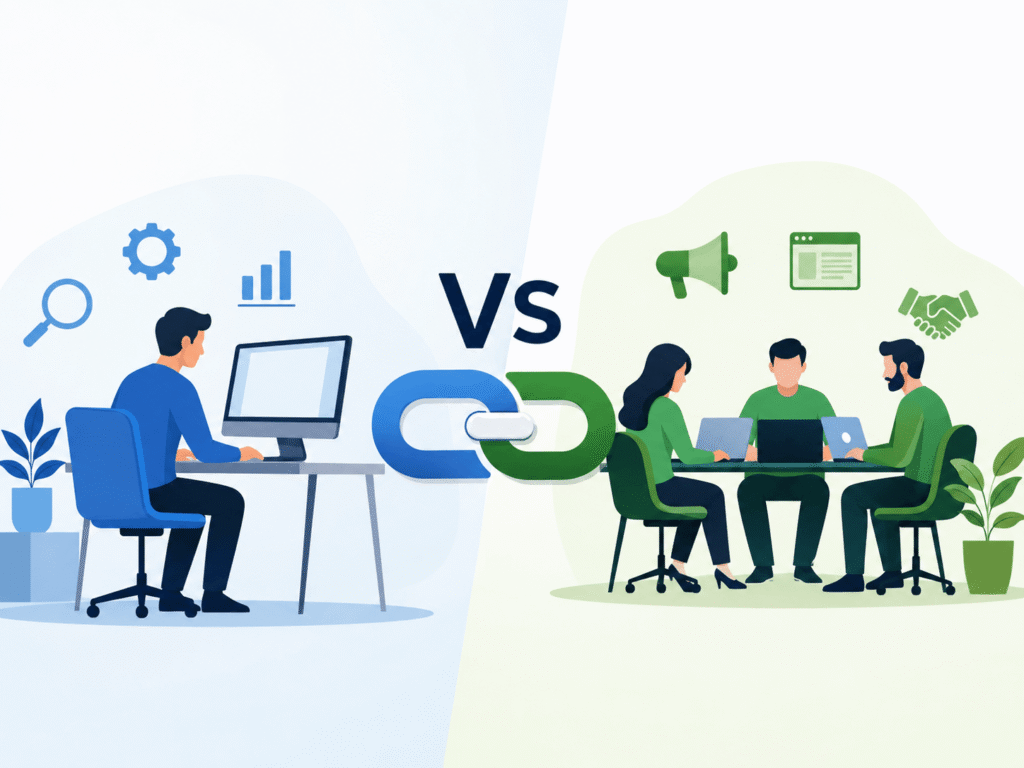
At some point, most businesses serious about SEO face the same decision: build link building capability internally, or bring in an outside partner. Both paths can work, but they come with genuinely different resource requirements, tradeoffs, and risk profiles. Making the right choice depends heavily on your team’s capacity, expertise, and how central link building is to your overall growth strategy.
This guide compares in-house and outsourced link building honestly — covering the real advantages and limitations of each approach — to help you think through which fits your situation.
What In-House Link Building Involves
Building link building capability internally typically requires:
- Dedicated staff time for research, outreach, content creation, and relationship management
- Tool subscriptions (Ahrefs, Semrush, or similar) for prospecting and evaluation
- Content creation resources, whether from internal writers or freelancers you manage directly
- Ongoing relationship management with publishers and editors over time
- SEO expertise to guide strategy, evaluate opportunities, and avoid common pitfalls
What Outsourced Link Building Involves
Working with an outside link building or guest posting service typically involves:
- Existing publisher relationships the agency has built over time, potentially speeding up placement timelines
- Established vetting processes for site quality, though these vary significantly between providers
- Content creation handled by the agency, or in collaboration with your team
- A pricing structure based on placements, retainers, or campaign packages
- Reduced direct oversight of the outreach and placement process compared to in-house efforts
Pros and Cons Comparison
| Factor | In-House | Outsourced |
|---|---|---|
| Upfront cost | Lower direct cost, but requires staff time investment | Typically higher direct cost, less staff time required |
| Speed to results | Slower to build relationships and processes initially | Can be faster, leveraging existing publisher relationships |
| Control and oversight | Full control over process and site selection | Requires trust in the provider’s vetting standards |
| Scalability | Limited by internal team capacity | Can scale more easily with the right provider |
| Expertise requirement | Requires in-house SEO/outreach expertise | Relies on the provider’s expertise |
| Relationship building | Builds internal, long-term publisher relationships | Relationships are held by the agency, not your team |
| Quality consistency | Depends entirely on internal process rigor | Varies significantly by provider — requires careful vetting |
When In-House Link Building Makes Sense
- Your business has genuine in-house SEO expertise and content creation capacity
- Link building is a core, ongoing part of your long-term strategy, justifying the investment in building internal capability
- You want full control and visibility over every aspect of the outreach and placement process
- You have the bandwidth to build and maintain publisher relationships over time
When Outsourcing Makes Sense
- Your team lacks the bandwidth or specific outreach expertise to execute link building effectively in-house
- You want to move faster than building internal relationships and processes from scratch would allow
- You need to scale link building efforts beyond what internal capacity can support
- You’ve found a genuinely transparent, quality-focused provider willing to show you where content will be published before it goes live
Risks to Watch for in Both Approaches
In-house risks:
- Inexperienced internal teams may make common mistakes (over-optimizing anchor text, poor site vetting) without realizing it
- Slower initial progress while building relationships and processes from scratch
- Tool and resource costs can add up without necessarily producing proportional results early on
Outsourcing risks:
- Some providers use low-quality tactics (PBNs, link farms) without full transparency
- Quality can vary significantly between providers, making vendor selection critical
- Reduced direct oversight requires trust in the provider’s processes and standards
How to Evaluate an Outsourced Link Building Provider
- Ask directly about their site vetting process — traffic, relevance, spam signal checks
- Request transparency about where content will be published before it goes live
- Avoid providers promising guaranteed rankings or unusually cheap, bulk-priced placements
- Check for realistic, credible language about expected outcomes rather than inflated promises
- Look for evidence of genuine editorial standards in their placement examples
A Hybrid Approach
Many businesses land somewhere in between — building some internal SEO expertise and content capability while outsourcing specific aspects of link building (like outreach at scale) to a trusted partner. This can combine the oversight benefits of in-house involvement with the scalability and existing relationships an experienced provider offers.
FAQs
Is outsourcing link building more expensive than doing it in-house? Direct costs are often higher for outsourcing, but in-house link building requires significant staff time investment, tool subscriptions, and a learning curve — the true cost comparison depends on your specific situation and existing capacity.
How do I know if an outsourced link building provider is trustworthy? Look for transparency about their site vetting process, willingness to show placements before they go live, and realistic (not guaranteed) language about expected outcomes.
Can small businesses realistically do link building in-house? It’s possible, particularly with a smaller, more focused strategy, but it requires genuine time investment and at least foundational SEO knowledge to execute effectively.
Is a hybrid approach common? Yes — many businesses build some internal capability while outsourcing specific aspects, particularly outreach at scale, to a trusted external partner.
How long does it take to build in-house link building capability? This varies, but building genuine publisher relationships and refined processes typically takes meaningful time — often many months of consistent effort — compared to leveraging an established provider’s existing relationships.
What’s the biggest risk of choosing the wrong outsourced provider? The biggest risk is engaging a provider using low-quality tactics like PBNs or link farms without transparency, which can waste budget and potentially expose your site to SEO risk.
There’s no universally “better” choice between in-house and outsourced link building — the right decision depends on your team’s capacity, expertise, timeline, and how central link building is to your broader strategy. Many businesses find success with a hybrid approach, building some internal capability while leveraging a trusted outside partner for scale.
If you’re weighing your options and want to discuss what a transparent, quality-focused outsourced partnership could look like, Link Building Services is a good starting point for that conversation.
SEO Metadata
SEO Title: In-House Link Building vs. Outsourcing: Pros and Cons Meta Description: Compare in-house and outsourced link building honestly — costs, control, scalability, and how to choose the right approach for your team. URL Slug: /in-house-vs-outsourced-link-building Primary Keyword: in-house vs outsourced link building Secondary Keywords: should I outsource link building, link building agency vs in-house, DIY link building
Internal Linking Opportunities
| Anchor Text | Suggested Destination | Placement |
|---|---|---|
| Link Building Services | Services page | Conclusion CTA |
| how to choose a guest posting agency | Article #27 | “How to Evaluate an Outsourced Link Building Provider” section |
| guest posting for startups | Article #23 | “When Outsourcing Makes Sense” section |
| common link building mistakes | Article #18 | “Risks to Watch for in Both Approaches” section |
Suggested External Sources
- Search Engine Journal – Link building agency selection guidance
- Ahrefs – In-house vs agency SEO resourcing research
- Moz – Link building cost and ROI considerations